In industrial processes, many quality controls are carried out, usually visually. These inspection processes are carried out by people who sometimes objectively assess whether the piece in question is "good or bad".
They are generally repetitive processes that are interested in automating and establishing an objective and as stable as possible way to assess the quality of the manufactured part.
There are many applicable technologies for the automation of visual quality controls, from 2D cameras, linear cameras, etc. But, many times, the interesting thing is to know and measure the depths of the defects or deviations. For this, a 3D technology is necessary, such as laser profilometry.
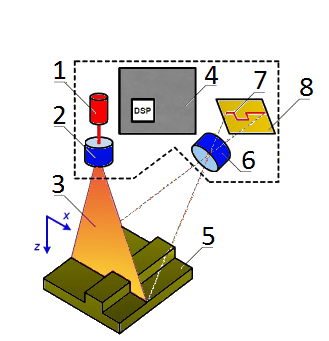
"The laser profilometry method is based on the processing of images of laser beams bent by the tested object profile. The figure depicts the simplest way to measure profile height. A narrow laser beam (1) passes through the diffraction module (2) and is converted into laser plane (3). The section of laser plane and tested object surface (5) is the tested object profile recorded by the camera (6). The profile image (7) made on the photosensitive matrix (8) is sent to the signal processor (4) where it is processed and the absolute millimeter dimensions of the object are calculated." (source: Laser profilometry | Oktanta NDT (oktanta-ndt.ru))
They are generally repetitive processes that are interested in automating and establishing an objective and as stable as possible way to assess the quality of the manufactured part.
There are many applicable technologies for the automation of visual quality controls, from 2D cameras, linear cameras, etc. But, many times, the interesting thing is to know and measure the depths of the defects or deviations. For this, a 3D technology is necessary, such as laser profilometry.
"The laser profilometry method is based on the processing of images of laser beams bent by the tested object profile. The figure depicts the simplest way to measure profile height. A narrow laser beam (1) passes through the diffraction module (2) and is converted into laser plane (3). The section of laser plane and tested object surface (5) is the tested object profile recorded by the camera (6). The profile image (7) made on the photosensitive matrix (8) is sent to the signal processor (4) where it is processed and the absolute millimeter dimensions of the object are calculated." (source: Laser profilometry | Oktanta NDT (oktanta-ndt.ru))
The applications are endless in the nuclear and social field. It can be used for quality control in prismatic extrusion parts, in flat lamination parts to measure their flatness, quality control of welding seams, rails for trains, etc. And in the social field, to control the state of the roads, reconstruction of sculptures, monuments (for example Notre Damme), etc.

No hay comentarios:
Publicar un comentario